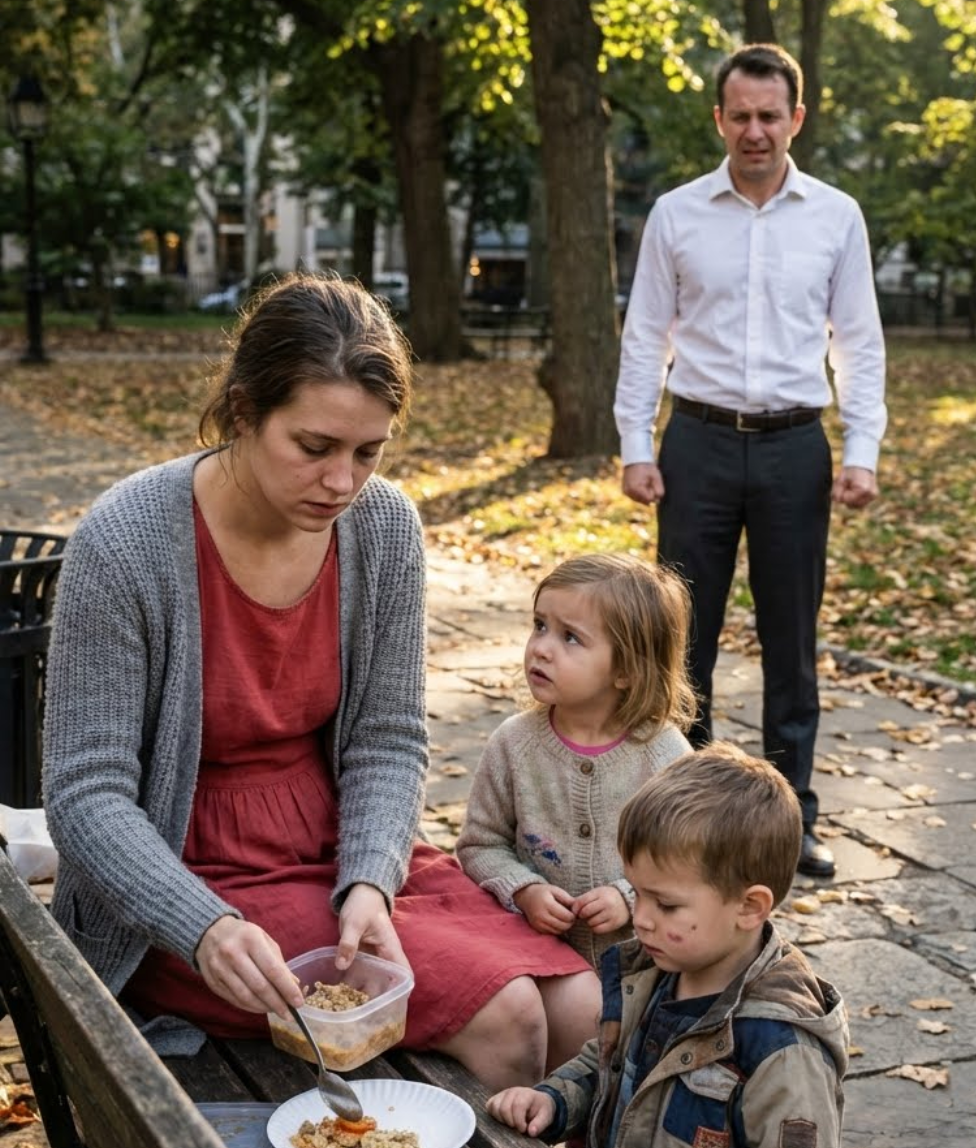

For nearly two months, Leonardo drifted through Plaza Fundadores as though he were moving through a world that no longer belonged to him.
Since his father’s death in early autumn, life had continued at its usual pace—vendors shouting over baskets of corn, children chasing laughter across the stones, couples pausing to hold hands by the fountain—but Leonardo felt sealed off from it all.
At thirty-nine, he possessed everything people admired: a thriving real estate empire, a spotless home in Colinas del Valle, and a name that opened doors. Yet the silence waiting for him every night felt heavier than any loss he had known before.
His father used to say it bluntly, without sentiment: “Go where people live their real lives. Money will never teach you what being human means.” Leonardo had always nodded, always agreed—and almost never followed that advice. Now, stripped of schedules and guarded routines, he wandered alone. No assistants. No phone calls. Just his footsteps and the echo of something unfinished.
That afternoon, November carried the scent of warm tortillas and damp soil from freshly watered flowerbeds. The shadows of tall trees stretched across the plaza, and the fountain murmured steadily, as if reminding the city that some things endure no matter what breaks. Leonardo paused, closed his eyes, and tried to locate the ache inside him. His father’s face surfaced in his memory—hollowed by illness, fingers gripping his hand with unexpected force. A grip that said don’t look away now.
Drawn toward the quieter edge of the plaza, Leonardo noticed a bench tucked beneath a broad ash tree. What caught his attention wasn’t spectacle or drama—it was restraint.
A young woman sat there, her frame slight, her posture tense. Resting on her knees was a white cooking pot. At her sides were two children: a boy around eight, hair cut unevenly, and a younger girl with eyes far too large for her thin face. Their clothes were clean but worn thin, preserved by care rather than abundance.
The woman—Karina—opened the pot and began to serve the food. She filled two portions generously and passed them to the children. Then she scraped together what remained for herself—a serving so small it barely deserved the name.
Leonardo stopped breathing.
He had negotiated million-dollar deals, watched men posture and boast, given to charities where applause followed checks. But this—this quiet surrender without witnesses—shattered something inside him. Giving without being asked. Choosing less so others could have more. A crack opened in his chest, and through it came something unfamiliar: clarity.
Karina focused entirely on her children. The boy whispered something that made the girl smile. She ate slowly, carefully, as if hoping the moment would last longer. Karina lifted her spoon with shaking hands—not from nerves, but exhaustion. Leonardo took a step forward, then stopped.
Don’t interfere, the world had taught him.
Don’t turn away, his father had taught him.
The city continued around them, indifferent. Then Karina swayed slightly, one hand pressing to her forehead. The boy reached for her, alarm flaring in his eyes. She forced a smile—thin, protective, unconvincing.
Leonardo moved.
He approached with care, voice low, chosen with intent. “Excuse me… I’m sorry to interrupt. Are you feeling alright?”
Karina looked up, startled. Her eyes were amber-colored, weary but proud. She adjusted her loose sweater, straightening as though dignity could be restored through posture alone.
“We’re fine, sir,” she said. Her voice cracked at the end.
The boy stepped in front of her instinctively.
Leonardo noticed everything—the pale skin, the shallow breaths, the tremor she couldn’t hide. “Forgive me for asking again… but you don’t look well. Would you like me to call someone?”
She shook her head, offering a practiced smile. “God will provide.”
He didn’t consider himself religious, but hearing faith spoken by someone holding so little disarmed him completely.
“When did you last eat a full meal?” he asked gently.
Karina looked away. The children clung to her arms. “This morning,” she said—but her body betrayed the lie.
Then everything collapsed.
The little girl—Camila—slipped from the bench. Her legs failed her mid-step, and she fell onto the gravel, unmoving. The pot tipped. Rice spilled across the ground.
Karina screamed.
The boy, Julián, dropped beside his sister, crying out her name. People turned. Murmurs rose. But no one acted.
Leonardo dropped to his knees. He felt for a pulse. It was there—but faint. Her skin was cold. Her lips cracked.
He didn’t hesitate.
He lifted Camila into his arms. She weighed almost nothing.
“We’re going to the hospital,” he said firmly.
Karina tried to protest. “Sir, I don’t have—”
“That doesn’t matter,” Leonardo said. “Come. Now.”
The drive through Monterrey blurred into urgency. Red lights, horns, noise—all irrelevant. In the back seat, Karina cradled Camila, whispering prayers through tears. Julián cried silently, as if conserving emotion the way he conserved food.
Leonardo gripped the steering wheel, checking the mirror again and again. He knew the hospital director. He had funded wings, signed plaques. Until now, it had felt distant.
Now it was everything.
And for the first time since his father’s death, Leonardo understood what had been missing—not success, not purpose, but presence.
He stopped in front of the emergency room, not caring that he was blocking traffic. He jumped out of the car, scooped Camila up, and ran toward the automatic doors.
The smell of disinfectant hit him, and the bright white lights made Karina look paler, more fragile. “I need a doctor now!” Leonardo shouted toward the counter. In seconds, paramedics appeared with a stretcher. They laid Camila down, checked her pupils, and connected her to oxygen.

Leave a Comment