
The security guard, an older man with kind eyes, noticed.
“First visit?” he asked politely.
—Yes —I replied—. I need to submit some reports.
He looked at the recipients (SEC, IRS, attorney general) and his expression softened with a silent acknowledgment.
“There’s a coffee cart upstairs,” he said. “Something hot would be nice. The staff in those offices are very attentive. You’ll be in good hands.”
I delivered each envelope directly to the appropriate office, making sure to receive sealed confirmations from the employees who likely processed returns like mine regularly. The IRS representative—a woman with steel-gray hair and reading glasses dangling from a chain—briefly placed her hand on mine.
“These investigations take time,” he said quietly. “But we review every credible submission.”
At 9:30 am, I was sitting in the lobby of the downtown Marriott, waiting for two women who had no idea that their morning was about to change.
Lydia Morrison arrived first, looking impeccable in a bespoke Chanel suit despite the early hour. Adelaide Whitman followed shortly after, wearing pearls on her collarbone and sporting a slight expression of uncertainty.
“Savannah,” Lydia said, brushing a light kiss against my cheek. “Your message was rather vague. What’s wrong?”
When I contacted them, I was deliberate: with enough urgency to ensure they came, but without enough detail to generate immediate loyalty to their husbands. Both were Travis’s most important clients. Both sat at my birthday dinner, laughing.
“There’s something you need to see,” I said, placing my tablet on the table. “What you decide to do after that is up to you.”
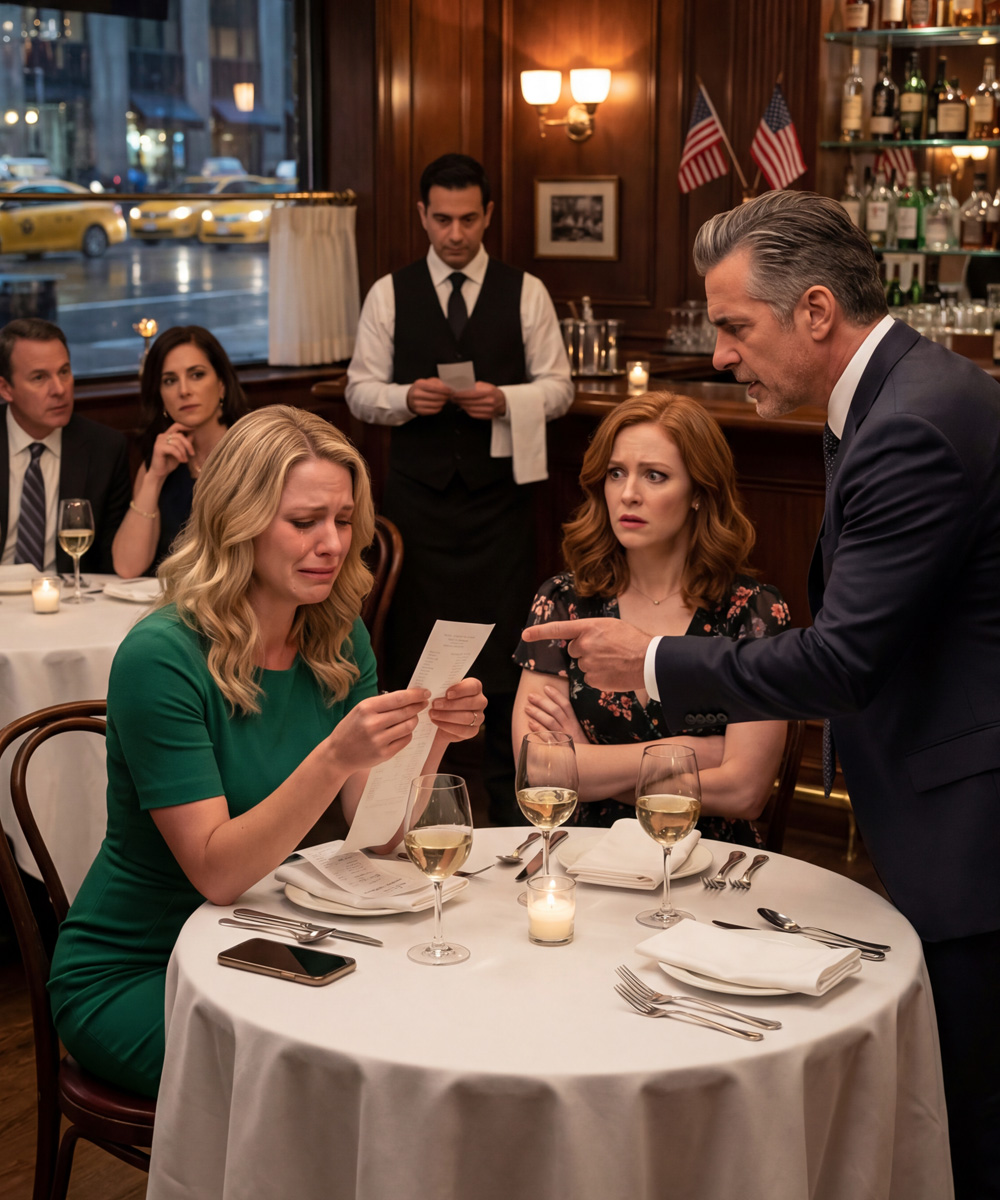
I started with the photographs: Travis at Le Bernardin, his hand resting on the lower back of a redhead. Travis entering the St. Regis with a blonde who was clearly not me. Then, the receipts: jewelry purchases that didn’t match any of her collections, hotel expenses on dates when she was supposedly traveling with her husbands.
“Why are you showing us this?” Adelaide asked, though she had already turned pale.
“Because their husbands were there,” I replied. “They knew. Here… dinner for four at Eleven Madison Park. Travis, Marcus, George, and some woman named Christine. That same night, George told them he was at a medical conference.”
Lydia grabbed the tablet, zoomed in, her breath coming in short gasps. “Robert said he shared a room with him at that conference. They claimed that saved the company money.”
“There was no conference,” I said cautiously. “I have emails that summarize the cover story.”
Adelaide’s fingers trembled as she pulled out her phone. “George’s secretary,” she murmured. “She always has his royal itinerary.”
She made the call, spoke in broken phrases, and ended it. Her expression shifted from disbelief to fury. “There was no conference. He was here all week.”
“They protect each other,” I said. “It’s a pattern. It’s been going on for years.”
Silence fell over the table as they processed the information. Then Lydia straightened up, her posture rigid and resolute.
“Send me all the files,” he said calmly. “All of them.
” “Me too,” Adelaide added quietly.
I transferred the evidence, watching as determination replaced surprise on their faces. They were no longer spectators.
Later, I met David Yamamoto at a small restaurant near his newspaper office. He sat at the table across from me, barely containing his anticipation. He had been investigating Travis’s law firm for months, suspecting wrongdoing, but without proof.
“You mentioned the documentation,” he said, with the notebook already open.
I placed a USB drive on the table. “Financial records. Internal emails. Evidence of embezzlement from senior clients. Everything needed to corroborate your report.”
As she reviewed the files on her laptop, her expression changed to one of astonishment. “This is substantial. How did you manage this?”
“I lived with it,” I replied. “I simply chose to see it.”
“Morrison’s account alone is newsworthy,” he said quietly. “These repeated withdrawals, if he’s willing to speak publicly…”
“Wednesday morning,” I said firmly. “Not before. I need forty-eight hours.”
He studied me for a moment, understanding what I wasn’t saying out loud.
—Wednesday—he agreed. First edition. By noon, everyone will know.
I left the restaurant feeling strangely weightless, as if every step I had deliberately taken had lifted a weight I had carried for years.
My last stop was Emma’s house, a modest two-story colonial home in Queens that smelled of coffee and tranquility. She opened the door before I even knocked and hugged me so tightly it broke the shell I’d been keeping.
“I saw the recording,” she murmured between my lips. “Henri sent it. It made me want to burst into that restaurant and drag you out myself.”

Leave a Comment